Man and Van Bath: Staircases, Permits and Hourly Prices
Bath's Georgian housing is the reason an hourly booking here needs describing carefully. A crescent has no back door, the parking is resident-permit, and the staircase is a tall narrow well that turns twice. Here is what a man and van in Bath costs and what to check before you book.
The staircase is the bottleneck, not the door
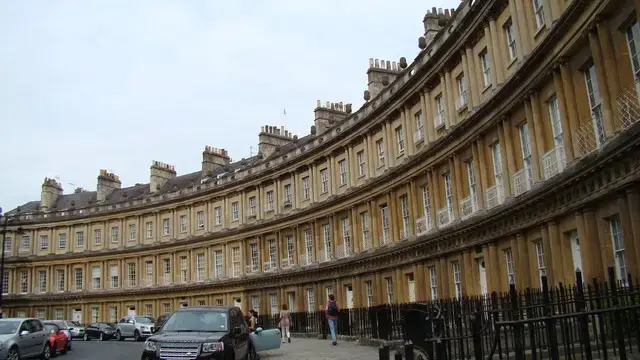
A Georgian terrace or crescent has one way in and out: the front. There is no rear access, the street is resident-permit parking, and many houses have a basement area with railings and steps down to it.
Inside, the main staircase is a tall narrow well that turns at least twice, often with a slim half-landing between. Anything that will not make the first turn will not make the rest, and on a listed building forcing it is not an option — a scraped handrail in a protected interior is a serious matter rather than a scuff.
Measure your largest items against the narrowest point of the stair, not the doorway. Sofas and wardrobes are the usual casualties, and some genuinely have to be dismantled or left behind.
- Say whether the property is listed, and which floor.
- Measure the narrowest point of the staircase.
- Check whether a permit bay can be suspended for the day.
- Ask what the firm's insurance covers for damage to the building.
How much does a man and van in Bath cost?
Hourly, with a one or two-hour minimum. National estimates put a solo driver near £64 an hour and about £78 with a second person (Checkatrade, 2026). Bath sits toward the upper end, being a high-demand city with difficult access.
That access is why the second carrier is usually worth it here. On a Georgian staircase almost everything needs two people regardless of how many are booked, so paying for one driver often costs more in hours than it saves in rate.
Past a two-bed a fixed-price crew is cheaper per item — compare removal companies in Bath for that. The removal costs guide lists prices by property size and the cost calculator will check a quote.
Get man and van quotes in Bath
The clean air zone and the parking
Bath operates a charging Clean Air Zone covering the central area, and it can apply to vans as well as larger vehicles. Rates and exemptions change, so check the registration on the GOV.UK clean air zone service rather than assuming, and ask whether any charge sits inside the quoted price.
Parking is the other central cost. Most of the city is resident-permit, and a van left on a permit bay collects a ticket somebody has to pay. Bath and North East Somerset can usually suspend a bay for a move given notice, which is almost always cheaper than a long carry or a fine.
Which BA areas do drivers cover?
The city routinely: the central terraces and crescents, Lansdown, Widcombe, Bathwick, Oldfield Park and Twerton, and the newer housing at Odd Down.
BA then reaches out to Radstock BA3, Midsomer Norton BA3 and Frome BA11 in Somerset, with Keynsham sitting on the Bristol boundary.
Bristol is twelve miles away and crews work both directions constantly, so a Bath–Bristol move prices as extended local work rather than a long haul.
Which van size fits your load?
Short-wheelbase Transit for a room or a few large pieces; long-wheelbase for a studio or a one-bed; a 3.5-tonne Luton with tail-lift for a one or two-bed flat.
In the central terraces the smaller van frequently wins. It parks where a Luton cannot, and since the staircase is the real bottleneck the extra load space rarely helps. On the approaches out to Odd Down and Keynsham the Luton is the sensible default.

Booking it without overpaying
Compare several prices and describe the building rather than the postcode. In a city where the architecture decides the timings, that description does most of the work.
- Say listed, which floor, and how the staircase turns.
- Sort a bay suspension before booking the van.
- Ask whether any clean air charge is inside the price.
- Confirm the minimum booking and part-hour rounding.
- Two universities make June and September busy.
Freeholders, managing agents and shared entrances
A great many central Bath houses are divided into flats, and that adds a layer most people do not think about until the morning.
Shared entrances usually have a communal door that self-closes, and carrying past one single-handed is slow. Ask whether it can be propped, and whether the managing agent needs to know a move is happening — some buildings require notice, and a few restrict moving hours entirely.
Where the property is listed, the freeholder may have views about protecting the staircase and the front door. That is not obstruction; it is the same instinct that has kept the building standing. Agreeing it in advance is far easier than negotiating it while somebody holds a wardrobe.
If you are a tenant, check your agreement for anything about moving in or out. Restrictions on weekend moves are not unusual in the central terraces, and finding out on a Saturday morning is the expensive version.