Man and Van Dundee: Stairs, Slopes and Hourly Prices
A Dundee booking is priced by two things the property size does not tell you: which floor of the tenement you are on, and whether the street outside runs uphill. Both add carrying, and carrying is what an hourly rate buys. Here is what a man and van in Dundee costs and how to describe the job accurately.
The floor number and the gradient
Dundee's tenements are sandstone with a shared common stair and no lift. Everything is carried, because a trolley is useless on stone steps that turn. A third-floor flit is materially longer than a ground-floor one, and any quote that did not ask which floor has not accounted for it.
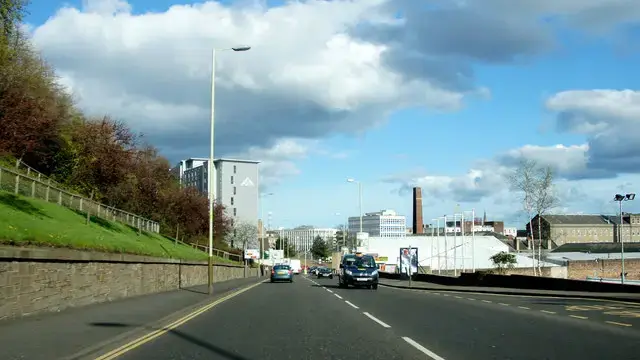
The gradient is the local addition. The city climbs the Law, so plenty of tenement streets run uphill, and the van may not be able to stop level with the close. When that happens the carry starts on the pavement before it reaches the stair.
- Give the floor number in your first message.
- Say if the street is on a slope and where the nearest level parking is.
- Mention whether the stair turns tightly at the half-landings.
- Name the heaviest item rather than counting boxes.
How much does a man and van in Dundee cost?
Hourly, with a minimum of an hour or two. National figures put a solo driver around £64 an hour and roughly £78 with a helper (Checkatrade, 2026). Scottish operators outside the central belt frequently price below that.
The second carrier is worth more here than the rate difference suggests. On a stair where everything is hand-carried, one person is less than half the speed of two, because the heavy items need a partner regardless of how many are booked.
Above a two-bed a fixed-price crew beats hourly — compare removal companies in Dundee for a fixed price instead. The removal costs guide covers prices by property size and the cost calculator checks a quote against them.
Get man and van quotes in Dundee
The easy end: waterfront flats
Not every Dundee address is a tenement. The new developments along the waterfront have lifts, level access and in most cases a proper loading bay, which removes almost everything that makes a tenement move slow.
If that is where you are moving from or to, say so — it changes the estimate substantially, and in your favour. A two-bed waterfront flat with a lift can be a fraction of the time a two-bed third-floor tenement takes.
Which DD areas do drivers cover?
The city routinely: the West End, Hawkhill, Lochee, Stobswell, Broughty Ferry and the waterfront.
DD then runs out along the coast and inland — Monifieth and Broughty Ferry DD5, Carnoustie DD7, Forfar DD8 and the Angus towns. Most drivers cover a good part of it.
Because a lot of local work runs along the coast rather than across the city, give both postcodes rather than place names and the drivers who cover the route will answer.
Which van size fits your load?
Short-wheelbase Transit for a room or a few large pieces; long-wheelbase for a studio or a compact one-bed; a 3.5-tonne Luton with tail-lift for a one or two-bed.
The tail-lift matters less than usual in Dundee, because the bottleneck is the stair rather than the tailgate — and on a sloping street it may not level safely anyway. What matters more is how close the van can get to the close door.
Changing your date, and what it costs
Student tenancies and Scottish missives both move, so a date that looked settled can shift at short notice. Most drivers are reasonable, but the terms are rarely volunteered.
Ask two things when booking: how much notice is needed to move the date without charge, and whether a deposit is refundable if the move falls through. A driver who turned work away for your slot deserves something, but the figure should be agreed beforehand rather than argued afterwards.
Booking it without overpaying
Get several quotes and describe the stair honestly. A driver expecting a ground-floor flat who finds three flights will either take much longer or revise the price on the doorstep.
- Floor number first, every time.
- Say whether the street is level or climbing.
- Ask about minimum bookings and part-hour rounding.
- Confirm fuel and waiting time are included.
- June and September book out around both universities.
Getting the flat ready before the van arrives
On a tenement stair the difference between a two-hour booking and a three-hour one is almost entirely preparation. There is no way to speed up carrying; there is every way to reduce how many trips it takes.
Everything boxed, taped and labelled before the driver knocks. Beds stripped and dismantled if they are coming apart. Nothing loose — a floor of carrier bags and unboxed kitchenware turns a tidy load into a dozen extra journeys up and down stone steps.
Two Dundee-specific additions. Prop the close door if you are allowed to, because carrying past a self-closing security door single-handed is genuinely slow. And make sure the stair light works — in winter a tenement stair at four in the afternoon is dark.
None of it costs anything, and on an hourly booking it is the largest saving available to you.